Belcarra Garden Club
BC, Canada
Seeds and Tubers and Corms, Oh My!
Ever wonder why those potatoes in your pantry are sprouting eyes? They're trying to become new plants!
Understanding the difference between seeds, tubers, and other plant parts is the key to knowing what you're planting
and how to help it thrive. It may still be winter, but gardeners are already dreaming of springtime planting!
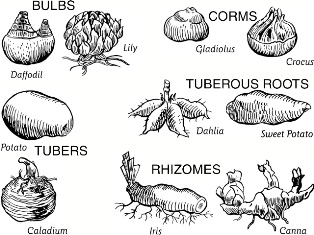
(This drawing is shown many places but I can't find the true artist!)
Seeds form when plants reproduce through pollination (yep, that's sexual reproduction!) They're packed with everything needed to start a new plant. Each seed is a unique individual with traits from both parents (like a human child). It is not a clone, so when you save seeds from a "hybrid" tomato, the baby plant might look totally different from the parent. Seeds are inexpensive and easy to store, but they require patience and specific conditions if you hope to start them early. Fun fact: Lotus seeds found in a dried-up Chinese lakebed germinated after 1,300 years! The smallest seed (an orchid) is dust-like, and the largest (a coconut) can weigh 40 pounds!
Seeds! 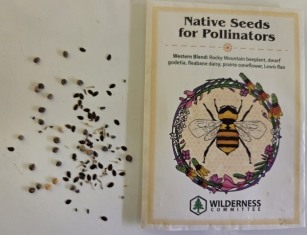
In vegetative propagation (asexual reproduction), the new plant grows from a piece of the parent, so it is a clone–genetically identical to the parent. Some types are stem tubers, underground root tubers, and above-ground spreaders.
Stem tubers are thickened underground stems that store energy (starch). They have "eyes" (buds) scattered over the surface (e.g., potatoes, caladiums, Jerusalem artichokes). Fun fact: Humans have grown potatoes for over 8,000 years and chose them as the first vegetables to grow in space in 1995.
potato eyes and sprout 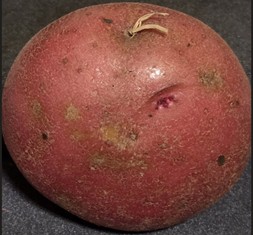
Rhizomes are horizontal underground stems that grow sideways. They send roots down and their shoots up. They usually have distinct nodes or joints (e.g., ginger, bearded iris, bamboo, cannas, mint). Fun fact: Bamboo rhizomes are strong enough to break through concrete.
Canna Lily rhizomes 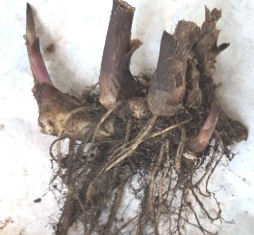
Bulbs are a short stem surrounded by fleshy leaves (scales) that store food. If you cut it in half, you see layers (e.g., onions, tulips, daffodils, garlic, lilies). Fun fact: Dutch tulip bulbs were worth more than gold in the 1600s.
bulbs 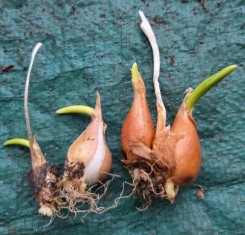
Corms look like bulbs on the outside, but if you cut them open, they are solid, not layered. They are essentially a swollen stem base (crocus, gladiolus, taro). Fun fact: The world's priciest spice, saffron, comes from a crocus!
Elephant Ears corms 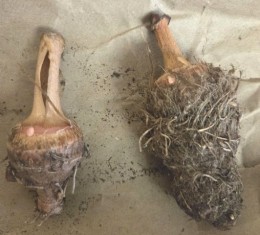
Root tubers are thickened underground roots (not stems), and they store energy. They don't have "eyes" all over. Sprouts usually only grow from the top crown where the stem was (e.g., sweet potatoes, dahlias, daylilies). Fun fact: sweet potatoes and regular potatoes are from completely different plant families!
Dahlia root tubers 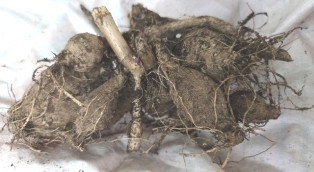
Stolons (runners) are ground spreaders. They have horizontal stems that grow "above" the ground. When a node touches the soil, it roots and creates a baby plant (e.g., strawberries, spider plants, creeping Charlie).
Strawberry runners 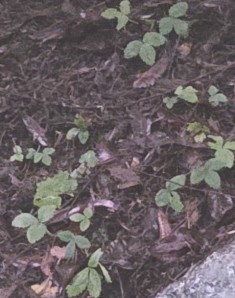 Creeping Jenny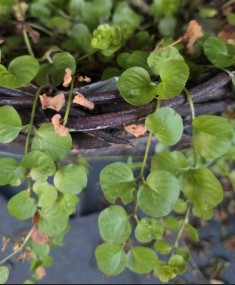
Funny note here: My favourite plant, begonias, may be fibrous-rooted (e.g., angel-winged begonias), rhizomatous (e.g., Rex begonias), or, as in the popular non-stop begonias, stem tubers (their "eyes" are usually located in the cupped area)!
Begonia stem tuber 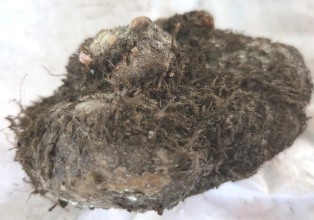
What a lot of amazing strategies to be found in our gardens!
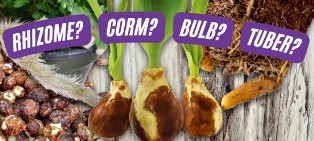
| Learn the Difference | Plant Nerd Series Episode 2
But just for fun,
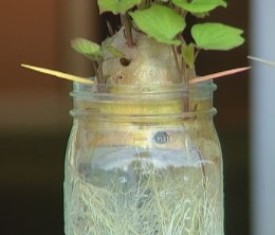
why not check your own veggie cupboard and grow your own potato!
red potato 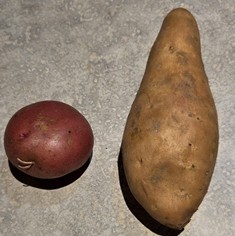 sweet potato
| White potato in water image from artofit.org |
 |
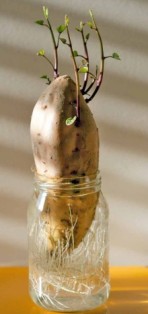 |
Sweet potato in water image from secondstorywindow.net |
|---|
Related Links:
Differences between tubers, rhizomes, corms, bulbs explained in more detail!
The Spruce
https://www.thespruce.com/corms-different-from-bulbs-tubers-and-rhizomes-2131032
Thursd is the Global Floral Industry Magazine & Platform
https://thursd.com/articles/explained-bulbs-tubers-rhizomes-corms-and-many-more
Farmer Gracy
https://www.farmergracy.co.uk/blogs/farmer-gracys-blog/bulbs-corms-tubers-rhizomes-differences
A nice video showing the differences
https://www.youtube.com/watch?v=FKs8iJjxLeY
Rhizomes, Corms, Tubers, and Bulbs, Oh My! | Learn the Difference | Plant Nerd Series Episode 2
https://www.youtube.com/watch?v=YwtNCQnmUpk
Growing Potatoes in Water (a fun activity!)
Potato Science project!
https://www.sciencing.com/grow-potato-water-science-project-6239373/
GreenGardener - a simple sustainable guide
https://greenygardener.com/how-to-grow-a-potato-plant-in-water/
Lucky Science: Growing Potatoes
https://www.secondstorywindow.net/lucky-science-potatoes/
Harvest Home
https://hydroharvesthome.com/growing-potatoes-in-water-a-complete-guide/
